
Yuheng Li 李雨恒
Ph.D. Candidate · Department of Data Science · William & Mary
I am a Ph.D. candidate, cosupervised by Haipeng Chen and Yanhai Xiong. My research spans reinforcement learning, diffusion models, and large language models — building complex decision systems that are capable, efficient, and reliable. I'm currently working on diffusion language models, especially on arbitrary-order generation and token embedding.
Research
My research focuses on building learning systems that are capable, efficient, and reliable for complex real-world decision-making (e.g., adversarial attacks, unknown environments), using multi-agent reinforcement learning and diffusion models — I care not only about whether a model performs well, but about why it works and whether we can trust it in practice.
- Diffusion language models, especially arbitrary-order generation and token embedding
- RL post-training for diffusion / semi-autoregressive language models
- Develop/Integrate vision-language models (VLMs) for complex decision-making problems such as route planning, to improve performance and reliability
- Multi-agent and game RL for decision-making under more real and complex conditions like robotics/game
News
Selected Publications
Abstract
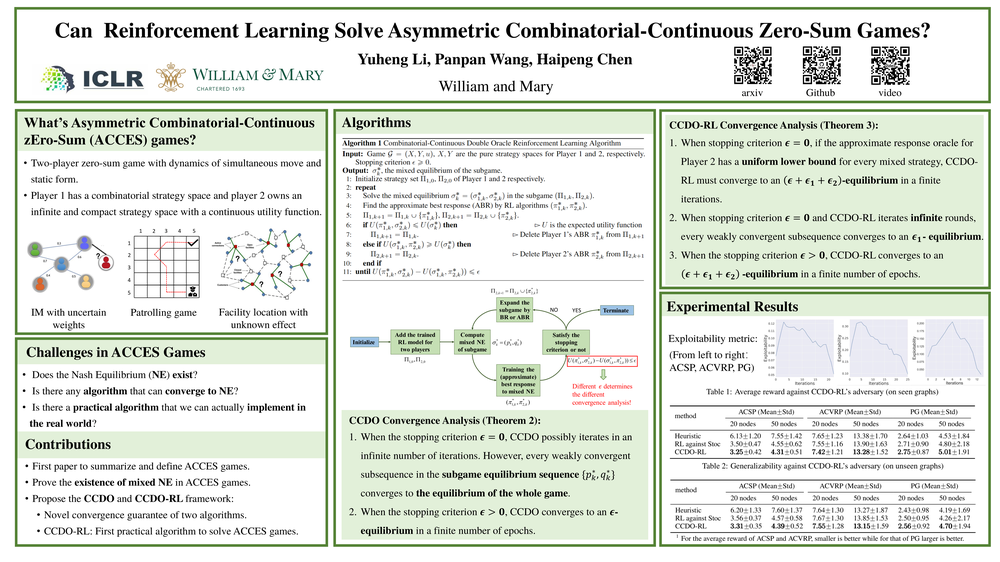
Existing work on learning in zero-sum games largely assumes symmetric or matrix-form strategy spaces. We define and study ACCES games — two-player zero-sum games in which one player chooses from a combinatorial action space and the other from an infinite, continuous one — a structure that arises naturally in combinatorial optimization under adversarial or uncertain parameters (e.g., routing, covering, and patrolling). We prove a mixed Nash equilibrium exists via essentially-finite-game approximation, then propose CCDO, a combinatorial–continuous double-oracle solver with convergence guarantees, and its practical variant CCDO-RL, which uses reinforcement learning to compute approximate best responses. On adversarial covering-salesman, capacitated-routing, and patrolling games, CCDO-RL converges to approximate equilibria and generalizes to unseen instances.
Abstract
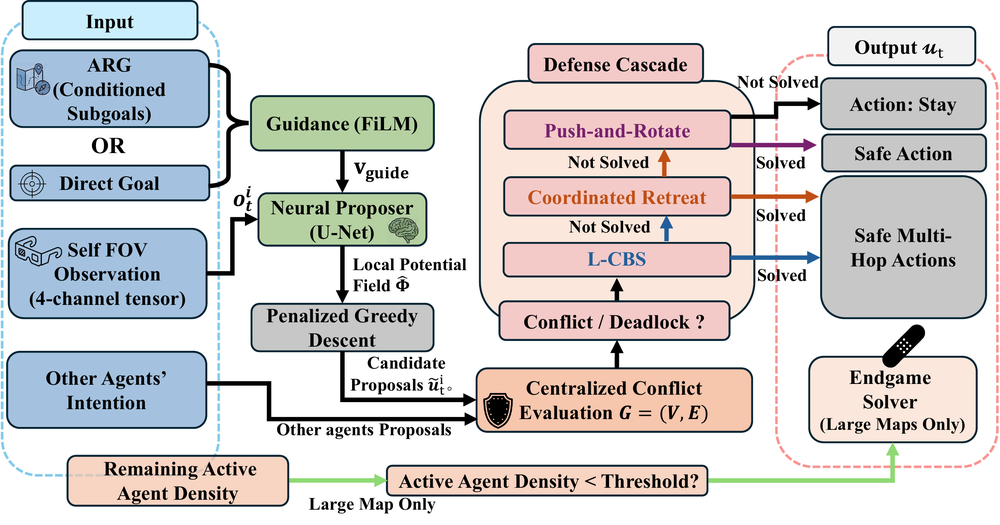
LENS tackles centralized, partially observable multi-agent path finding (PO-MAPF), where a team must navigate and coordinate in an environment it discovers as it moves. Rather than one-step reactive policies or global-search-with-local-repair, LENS runs search locally over anticipated conflict groups and learns to regress a continuous potential field — a dense prediction (a U-Net proposer with FiLM guidance) that captures longer-horizon structure and helps agents recognize and pass through bottlenecks. A conflict-resolution cascade (L-CBS, coordinated retreat, push-and-rotate) then guarantees locally collision-free motion within bounded spatio-temporal windows, without large-scale end-to-end policy learning.
Experiences